


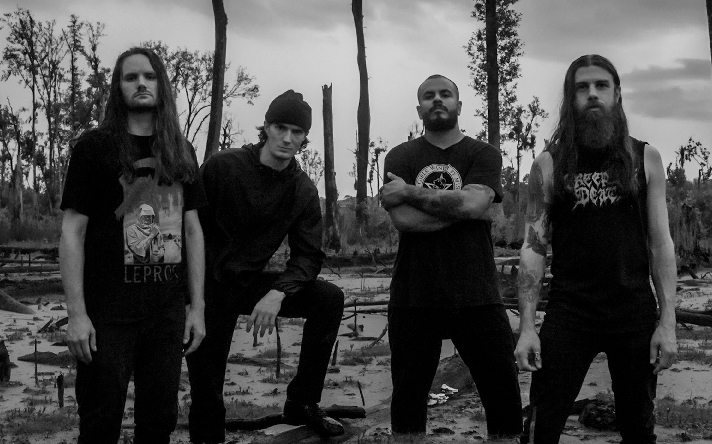
Rhythm Of Fear worship at the altar of thrash metal and crossover. Summoned from the sadistic swamps of Jacksonville, in the heavy metal-rich soil of the state of Florida, the masters of gargantuan groove conjure a reverence for the form unrivaled by their peers. Committed to unrelenting riffage, Rhythm Of Fear gleefully reinvigorates the timeless collision of speed, musicianship, and attitude.
Unapologetic bangers like “Dark Energy” and “Ten Theories” quickly became underground classics to a growing legion of like-minded supporters who snapped up the band’s 2011 demo, the Mass Illusion EP (2015), and full-length debut, Maze of Confusion (2016). The appetite for devastation only intensified with the Ritual Dementia EP (2019), featuring “Vortex of Torment,” and Rhythm Of Fear’s impassioned take on “Over and Out,” a deep cut from the early power metal years of Pantera.
Now the band threatens to conquer the hearts and minds of all in metaldom with the vitriolic, thrashtastic, circle-pit-inciting Fatal Horizons, a sophomore slab of cleverly crafted crossover frenzy. Joey Jones (Royal Thunder, Cloak) handled production, engineering, and mixing duties. Richly thematic and devilishly accessible in equal measure, Fatal Horizons leaps forward creatively, symbolized by the sci-fi/horror artwork from Mario Lopez (Toxik, Skeletal Remains, Evil Invaders).
As No Echo observed, “There are a ton of bands working within the stylistic parameters of crossover thrash these days, but few possess the songwriting smarts and technical proficiency of Rhythm Of Fear.” The band’s degree of excellence owes much to the more widely recognized genre forebearers. But perhaps just as crucially, Jay Santiago (vocals), Cody James (guitar), Logan Miano (drums), and Justin Styron (bass) devour a wide range of diverse and obscure metal bands to craft their own brew.
“Sanctuary, Sacrifice, Midas Touch, I could go on and on,” Santiago gushes. “Of course, there are the Big 4 bands everybody gravitates toward, but we tend to go for the stuff not as many people know.”
Chief among those influences is a crucial group of bands active from the late ‘80s to the early ‘90s, whom Rhythm Of Fear lovingly refers to as “the trinity.” Chicago’s Cyclone Temple, from Chicago (and the ashes of the band Znöwhite); Seattle powerhouse Forced Entry; and Slammer, from the UK.
“On Fatal Horizons, we’ve come even more into our own,” Santiago points out. “Maze of Confusion was very thrash metal and very hardcore driven. Aside from our lead guitar player, all of us grew up in the hardcore scene. We established ourselves as a true crossover band, with fast metal parts and funky hardcore grooves. There’s still a bit of groovy flavor, but Fatal Horizons is even thrashier.”
Alien abduction, magic rituals, and the occult pepper their songs with personality and spirit. Fatal Horizons delves deeper into the human psyche with relatable themes of depression, addiction, and anger. The justice system and politics are targets within the framework of broader fantasy metaphors.
Album opener “Obsolescence” confronts addiction. “Alien Synthesis” is about the aftermath of the abduction. The title track puts the listener at the center of a black hole. “Parasomniac” details Santiago’s struggles with the sleep disorder EHS, aka Exploding Head Syndrome, which awakens sufferers with imagined sounds. The simulation hypothesis is at the heart of “Simulated Times,” inspired by one of Santiago’s dreams. “Tears of Ecstasy” is loosely based on Clive Barker’s Hellraiser. There are instrumental interludes throughout Fatal Horizons, synergizing the cosmic themes of mortality. “Ceremony Of Sacrifice” closes it all with an exploration of Mayan and Aztec mythology.
The group’s potent blend of savagery and celebration earned them multiple dedicated converts on the road, touring with subculture icons like Agnostic Front, Leeway, Merauder, and Madball; newer bands, including Code Orange; and opening Florida shows for Cannibal Corpse and Sacred Reich.
Rather than simply rehash the past, Rhythm Of Fear absorbs and examines metal history’s greatest strengths, reassembling the parts into a fresh Frankenstein forged by the band’s unique identity and experience. “A barrage of distinctive thrash metal and heavy metal rhythms,” wrote The New Fury. Or, as Metal Crypt put it even more succinctly, “This is straightforward, merciless, [and] in-yer-face.”